
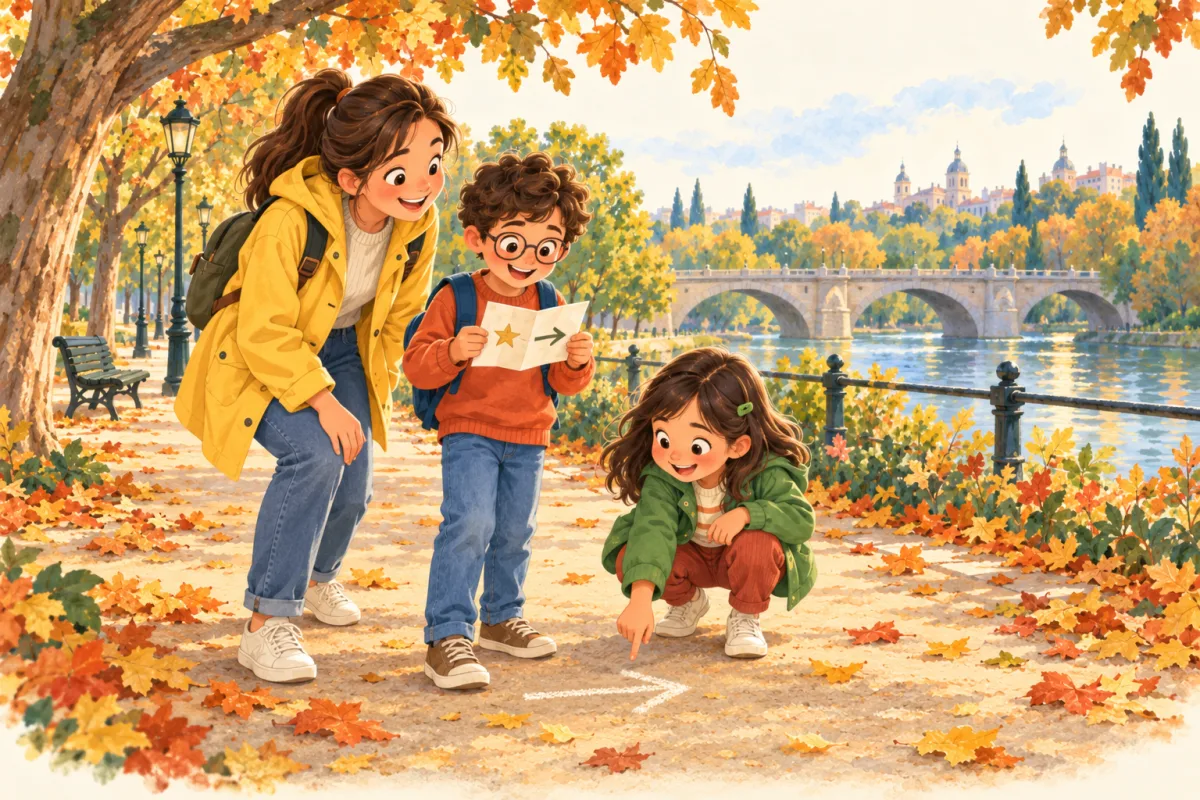
A scavenger hunt around the city is one of the best-loved plans for 6 to 9 year olds: there's a mystery, there are clues, there's a bit of running and, at the end, something to discover. And you don't need to hire anyone. With a morning, a little preparation and an area you know, you can put one together as a family.
Here's how to plan it step by step, which kinds of challenge work at this age, and an example to do in Madrid Río.
1. Pick a small area you know
Aim for a route of 45 minutes to an hour and a half, with a stop every few minutes. A pedestrian area or a park is best, with places to sit and a toilet nearby. Go there beforehand, even just on the map, to check that every stop exists and is easy to spot.
Tip: start and finish somewhere with something nice nearby, like a sunny bench or a place for a snack. The ending is part of the prize too.
2. Make up a story
A scavenger hunt without a story is a to-do list; with a story, it's an adventure. One sentence is enough: "Someone has lost a map and only we can put it back together", or "An explorer left five signs before setting off". Tell it at the start, in your most mysterious voice.
3. Write five clues
Five stops is a good number at this age: enough to feel progress, not so many that they tire. Write each clue on a folded, numbered piece of paper and keep them in an envelope the grown-up carries. Each stop gives a letter, a number or a drawing, and at the end, put together, they reveal the word or the place of the "treasure".
4. Mix up the challenges
At this age it works to alternate different kinds of challenge so nobody gets bored:
- Looking: "Find something red that doesn't move" or "Which animal can you spot here?".
- Counting: "How many arches does the bridge have?" or "How many benches are in this square?". Check the number yourselves first.
- Moving: "Get to the biggest tree in giant steps" or "Hop back to the start on one leg".
- Riddles: short, with only one possible answer in that spot.
- Codes: each letter is its number in the alphabet, or the word is written backwards.
- Drawing or inventing: "Draw what you can see from here" or "Make up a name for this place".
5. The grown-up as a discreet guide
The idea is for the children to read, think and decide. The grown-up carries the envelope, keeps an eye on crossings and gives an extra hint if someone is stuck for more than a couple of minutes. With siblings of different ages, share out the roles: one reads, one searches, one writes things down.
An example: a scavenger hunt in Madrid Río
Madrid Río is the long park that runs beside the Manzanares river, with wide paths, play areas and several bridges. This example follows the riverbank between the Puente de Segovia and the Puente de Toledo; look at the route on a map before you go and adjust it to your pace.
The story: "An old boatman left five signs along the river for anyone who wanted to find his favourite spot."
Clue 1. Puente de Segovia. One of the oldest bridges in Madrid, from the late 16th century. Count its arches and write down the number: that's your first key.
Clue 2. By the water. Find a spot where you can see the river up close. Stay quiet for one minute: what can you hear? Are there ducks or other birds? Write down the first animal you see.
Clue 3. A play area. Pick a swing or a slide and draw it on your paper in under a minute. Don't forget the oddest detail!
Clue 4. Along the way. Find one leaf of each colour: green, yellow, orange and brown. Once you have all four, write down how many steps you've taken since the last clue (roughly, rounding is allowed!).
Clue 5. Puente de Toledo. An 18th-century bridge with stone figures in the middle. Find them: what do you think they're looking at? Make up together who they are before reading about the place.
The treasure: put your keys together (a number, an animal, a drawing, another number and your story) and choose together the "boatman's spot": the place on the route you liked best. That's where you have your snack.
Good to know
- How long: allow a good hour with stops and some time in the play areas.
- Getting there: the park has several entrances along the river; pick the nearest on a map or on the Madrid transport authority's website (Consorcio Regional de Transportes).
- What to bring: the envelope of clues, a pencil, water and a snack.
- With a buggy: the paths in Madrid Río are wide and flat, easy with a buggy.
- Safety: agree a meeting point in case anyone gets separated, and go over the rules for crossings and near the water.
No time to put one together?
That's exactly what Paseo y Pista makes: paper adventures with a story, clues, missions and a map, ready to take out around Madrid with children aged 6 to 9 and a grown-up, without a guide or a phone. The Madrid pack has four, around El Retiro, Puerta del Sol and Plaza Mayor, the Royal Palace and the Temple of Debod, and the Literary Quarter. If you like looking at the city through a magnifying glass, there's another idea in streets with a story.