
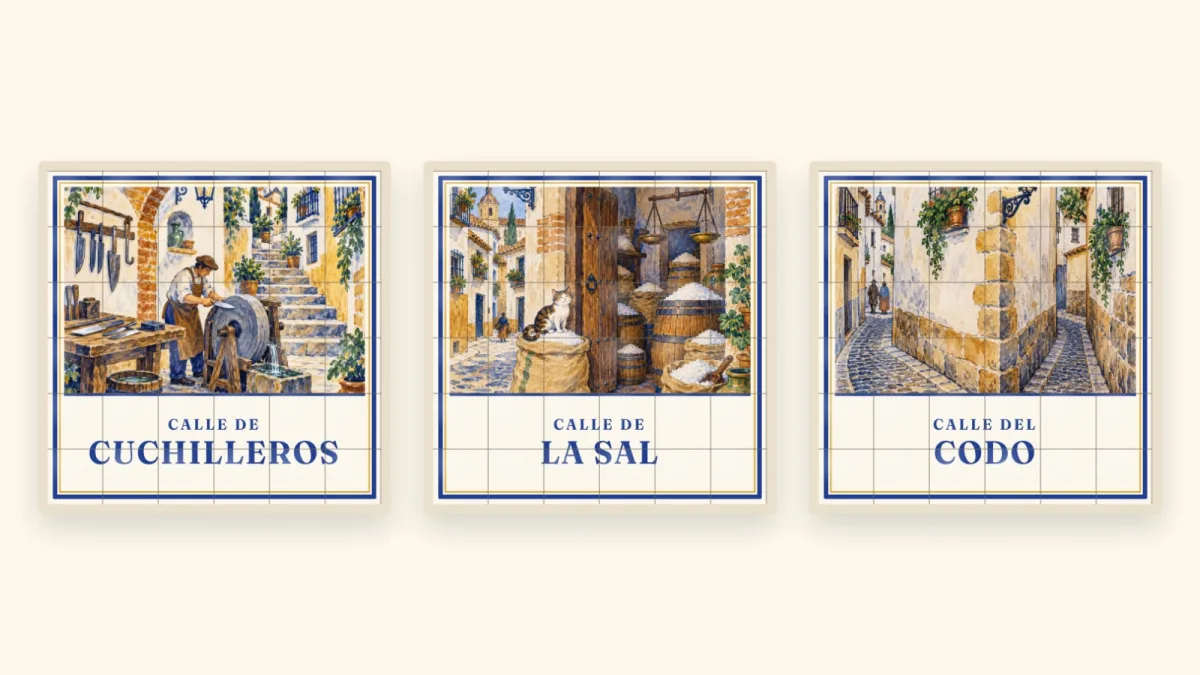
In the centre of Madrid, plenty of streets are named after something: a trade, a product, an odd shape or a legend. And on many corners the name is written on a ceramic tile sign with a picture that hints at where it comes from. Some of them were painted by the ceramicist Alfredo Ruiz de Luna, from a family of tile makers in Talavera de la Reina.
Here's a walk of about 45 minutes, from Callao to Plaza de la Villa, made for children aged 6 to 9 with a grown-up. Five streets, five stories and one question for each stop. No tickets, no phone: just look up.
A game before you set off: everyone picks a street from the list and, without looking anything up, makes up why it's called that. At the end of the walk, compare your theories with the real story.
1. Calle del Desengaño: Goya and a perfume shop
Getting there: from Plaza de Callao, pop up to Plaza de Soledad Torres Acosta, just behind it. That's where Calle del Desengaño begins.
What the name means: a desengaño is when you find out something isn't what it seemed. The story goes that, centuries ago, two knights were about to fight here over a mysterious lady hidden under a veil. When they finally saw her face, she wasn't what they expected at all, and they cried: "¡Qué desengaño!", "What a letdown!"
The true story: the painter Francisco de Goya lived on this street. In February 1799 he announced in the Diario de Madrid that Los Caprichos were on sale: 80 prints poking fun at the habits and silliness of his time. They weren't sold in a bookshop but in a perfume and liqueur shop at number 1, in the same building where he lived. A few days later, Goya took them off sale, probably for fear of trouble with the Inquisition.
What to look for: the street-name sign. Before you look, what would you draw to tell the story of the two knights?
A question for the way: if you made your own drawings, which shop in the neighbourhood would you sell them in?
2. Calle de Postas: horses and letters
Getting there: head back to Callao and walk down Calle de Preciados to the Puerta del Sol. Cross the square to where Calle Mayor begins; Calle de Postas leads off on the left.
What the name means: this is where the post chaises used to leave from, horse-drawn carriages that carried travellers and mail. At the posts along the road, tired horses were swapped for fresh ones so the journey could go on.
What to look for: the sign on the corner. Is there an animal on it? What do you think the carriage would be carrying?
A question for the way: invent a letter's journey: which streets would it travel down to reach your home?
3. Calle de la Sal: white treasure
Getting there: follow Calle de Postas a few steps and Calle de la Sal soon branches off, short and pedestrian, leading into the Plaza Mayor.
What the name means: salt was sold here. Madrid's chroniclers say it was kept in a store behind a big iron grille. Centuries ago, salt was precious: it kept meat and fish from going off long before fridges existed.
What to look for: the sign. Count how many steps the street is from end to end: it's one of the shortest on the walk.
A question for the way: if your street were named after something you keep at home, what would it be called?
4. Calle de Cuchilleros: the knife makers' workshops
Getting there: cross the Plaza Mayor to the Arco de Cuchilleros, in one of its corners, and walk down its stone steps.
What the name means: from the 17th century, the cuchilleros, the craftsmen who made and sharpened knives, had their workshops here. They were close to the meat stalls, and butchers needed good knives. The street follows the old ditch that ran alongside the city wall, which is why it curves and sits lower than the square.
What to look for: the sign and, while you're there, the shape of the street: does it go straight or bend? Look up, too, at how high the Plaza Mayor is from down here.
A question for the way: look at the names of the streets you pass: how many trades can you find hidden in them?
5. Calle del Codo: a street that bends its arm
Getting there: at the end of Cuchilleros, in Plaza de Puerta Cerrada, take Calle de San Justo and go up to Plaza del Conde de Miranda. Calle del Codo starts there. Keep a map handy: it's only a few minutes, but there are several turns.
What the name means: according to the chroniclers, it's named after its shape: it's narrow and turns sharply, like an arm bent at the elbow (codo). Bend your arm and compare it with the street.
What to look for: the sign. Here's a surprise: on the real tile sign, the picture isn't an arm but a codal, the piece of armour that protected a knight's elbow. Can you spot it?
A question for the way: find a strangely shaped street on the map and give it a new name.
The finish: Plaza de la Villa
Calle del Codo ends in Plaza de la Villa, one of Madrid's oldest squares. For centuries the city council met here, in the Casa de la Villa, and across the square stands the Torre de los Lujanes, from the 15th century, one of the oldest buildings in the city.
It's a good spot to sit down for a moment and bring out the theories from the start: did anyone guess why their street has its name? Which story did you like best?
If you'd like to keep playing, there are more ideas in screen-free family walks: observation games.
Practical tips
- How long: about 45 minutes with stops, roughly 1.5 km. With children who like to stop and look, allow an hour.
- Start: Plaza de Callao (Callao metro, lines 3 and 5).
- Finish: Plaza de la Villa, a few minutes' walk from Calle Mayor and from Ópera or Sol metro.
- Best time: in the morning, with good light for the signs and fewer people in the Plaza Mayor.
- With a pushchair: the Arco de Cuchilleros is a stone staircase; with a pushchair, check the map beforehand for a step-free way round to Plaza de Puerta Cerrada. The last streets are narrow and cobbled.
- The signs: not every street has an illustrated sign, and sometimes they're high up or hidden by building work. If you can't find one, tell the story anyway and draw it at home.
- The pictures in this article are signs we drew ourselves; the real ones are waiting for you on the corners.
New edition: Madrid
If you enjoy discovering the city like this, looking and asking questions, paseoypista.com has Paseo y Pista's illustrated booklets for exploring Madrid as a family: one walk through one place, with clues and missions for children aged 6 to 9 with a grown-up.