
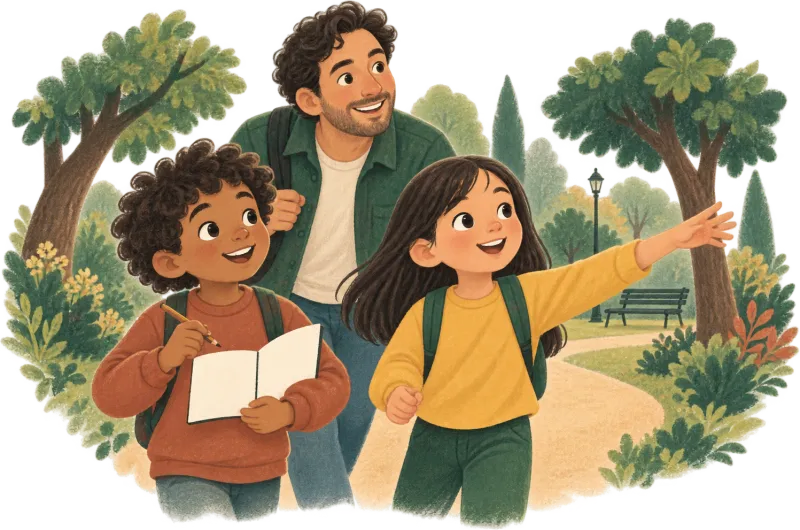
Madrid keeps mysteries. Your family solves them.
A walk can be just getting from one place to another… or a mission. The difference is a role for everyone, a couple of rules and a mind to look around. Here are seven walking games for children aged 6 to 9, each with an example in Madrid. None of them needs tickets or screens, and in every one the grown-up plays too.
Before you go: three agreements
- A role for every child. Eagle Eye searches, Compass picks the way and Quill writes everything down. With just one child, they can swap roles at every stop.
- The grown-up plays too. They search, guess and answer like everyone else. And they look after what isn't part of the game: crossings, traffic, the pace and when to head home.
- Phones in the bag, eyes on the street. Everyone at once, the grown-up's phone included. If you need the map or a call, take it out and put it back afterwards.
Bring a small notebook and a pencil: that's the team notebook.
7 walking games for Madrid
1. Eagle Eye: the tiniest detail
How to play: before you leave, the grown-up writes down five small things to find: a door knocker, an animal that isn't real, a date on a building, a stone face and an unusual house number. Eagle Eye holds the list and calls out each find. The grown-up looks for a sixth, harder item: if the kids spot it first, the team scores a point.
In Madrid: the streets of the old Madrid de los Austrias, around Calle Mayor, are full of old doorways, iron balconies and detailed façades. A good place to look up.
2. Compass: you choose the way
How to play: the grown-up sets the playing area ("we stay inside the park") and a finish point. At every fork in the path, Compass decides: left, right or straight on. Every three forks someone else chooses, the grown-up included. The challenge: reach the finish without looking at the map, and find a corner you didn't know on the way.
The golden rule: Compass decides where; the grown-up decides when to cross. Safety is never a game.
In Madrid: Parque del Oeste, with paths that climb, dip and cross, is perfect for getting a little lost without getting lost at all. More ideas for letting kids decide in planning and decision-making at 6 to 9.
3. Quill: a letter at every stop
How to play: the grown-up thinks of a secret word of five or six letters, say PIGEON, and writes each letter on a folded slip of paper. At each stop the team completes a small challenge (find something, count something, guess something) and wins a slip, handed over out of order. Quill copies the letter into the notebook. At the end, who can work out the word? The grown-up keeps the letters… and mustn't give hints.
No preparation: at every stop, Quill writes down the first letter of whatever caught your eye most. At the end, try to make a word with those letters, or invent one and decide what it means.
In Madrid: in Madrid Río, each bridge over the Manzanares can be a stop, and between one bridge and the next there's time to think up the next challenge.
4. Street-sign detectives
How to play: in central Madrid, many streets have their name on a ceramic tile sign with a picture. Set ten minutes on the grown-up's watch and count how many picture signs you can find. Then pick one and have everyone make up why the street got its name. The funniest story wins, with another point for whoever gets closest to the truth.
In Madrid: the streets around Plaza Mayor and in La Latina are full of these signs. If one is very high up or hidden by building work, pointing at it counts. For a walk with the real stories, see streets with a story.
5. The sound with no name
How to play: sit on a bench and stay quiet for half a minute. Then, taking turns, each person describes a sound without saying what it is: "it's low, it comes from the left, it comes and goes". Everyone else guesses. For a harder version, Quill draws a circle in the notebook for the team and places each sound as a symbol where it came from. Can anyone guess what each symbol is?
In Madrid: a square with a playground and café terraces, like Plaza de Olavide in Chamberí, doesn't sound the same first thing in the morning as it does in the afternoon. Want to check?
6. Bench questions
How to play: every time the team sits on a bench, someone asks a question and everyone answers, the grown-up too. There are no wrong answers. A few to start with:
- If this bench could talk, what would it have heard today?
- Which animal in the park would you like to be for a while?
- What's the strangest thing you've seen since we left?
- If you could put a new statue here, who would it be?
In Madrid: the Retiro is full of benches. One question per bench, and let the kids choose where to stop.
7. The ending, at home: the team map
How to play: back home, get the notebook out. Compass draws the route from memory, Eagle Eye adds the details they spotted and Quill writes in the letters and street names. The grown-up gives the adventure its title.
To talk about at home: what was the best part of the walk? Which place would you show someone else? Which mystery is still unsolved? Write it down for next time.
Tips to make it work
- Two or three games per walk. Better to leave them wanting more than to work through the whole list.
- Swap roles. That way each child gets to search, decide and write.
- A nice ending. A sunny bench, a snack or choosing the way back.
- If someone doesn't want to play, that's fine. They can come along and watch; they often join in with the next game.
Frequently asked questions
Do these games work outside Madrid?
Yes. The examples are from Madrid, but every game works on any street, square or park.
Do we need to prepare anything?
A notebook and a pencil. Eagle Eye and Quill take five minutes at home; the rest you play as you go.
How we see it at Paseo y Pista
If you'd rather have a mystery we prepared, our new Madrid edition, the Misterios del centro pack, takes you out to solve four mysteries on foot around the Retiro, Puerta del Sol and Plaza Mayor, the Royal Palace and the Temple of Debod, and the Barrio de las Letras. Each child picks a role (yes: Eagle Eye, Compass or Quill), the grown-up gets challenges of their own and the whole team writes down what they find on the map. For children aged 6 to 9 with a grown-up.
Keep reading: Screen-free walks: 8 observation games and The family board: why solving mysteries together matters.