
Madrid keeps mysteries. Your family solves them.
In most outings with children, the grown-up tags along: carries the bag, checks the time and waits on a bench. In a Paseo y Pista mystery there is no bench. The children have their roles, the grown-ups have their crossword, and everything ends up in the same place: the family board.
What the board is
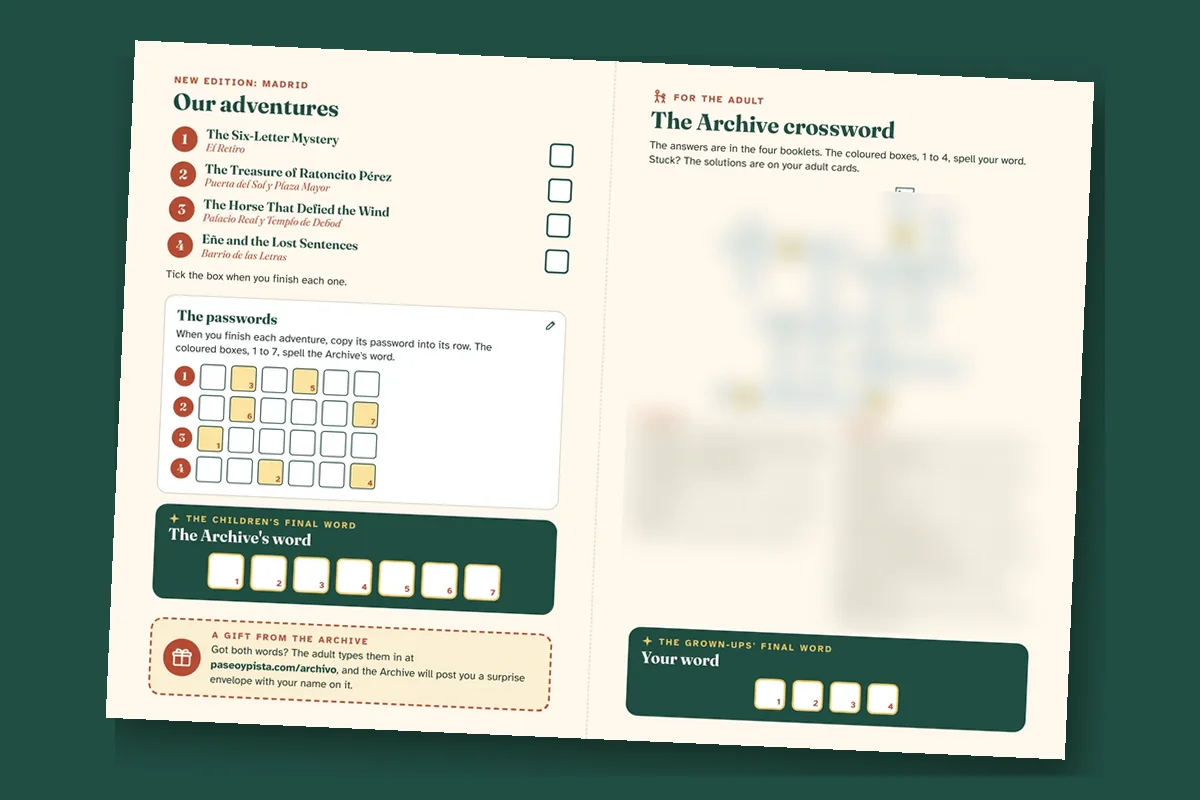
On the back of the Madrid map in the “Misterios del centro” pack is the board. It's the sheet where the team records everything it solves across the four adventures: Retiro Park, Puerta del Sol and Plaza Mayor, the Royal Palace and the Temple of Debod, and the Literary Quarter.
It has two halves, one for each part of the team.
The children's half
- Our adventures. Four boxes to tick as you finish each one.
- The passwords. Every adventure ends with a password, which goes in its own row. Some boxes are coloured and numbered.
- The Archive's word. The letters in the coloured boxes, in order, spell a secret word. You won't find it here: you have to go out and get it.
The grown-ups' half
- The Archive crossword. A crossword for the adult. The answers are hidden in the four booklets, so you really have to read them, not just come along.
- Your word. Just like the children's half, the coloured boxes spell another word.
And at the end, the gift: with both words, the adult goes to paseoypista.com/archivo and the Archive writes back by post, with a surprise envelope in your name. What's inside is, for now, another mystery.
Every mission, a clue
In each adventure, the team walks through a real place in Madrid and solves missions in front of the monuments. Every mission gives a letter; the letters give the password; and the password goes on the board. That way an afternoon in the Retiro leaves a mark at home, and the board fills up adventure by adventure, at each family's own pace.
Everyone plays
The children share out three role cards:
- Eagle Eye looks for the details and, if the team gets stuck, can ask for a hint.
- Compass reads where each mission is and, with the grown-up, leads the team there.
- Quill writes the letters down, notes what you discovered and makes the adventure drawing.
Meanwhile, the grown-up has a challenge of their own. It isn't a consolation prize: it's their part of the mystery, and without it there's no reply from the Archive.
Why playing together matters
You don't need a study to know that an afternoon of play as a family feels good. But trusted organisations do explain why, and we like to quote only what we can check.
On its website for families, HealthyChildren.org, the American Academy of Pediatrics (AAP) sums up the research like this:
- Play can improve children's ability to plan, organise, get along with others and regulate their emotions, and helps them cope with stress.
- Playing with parents and with other children is key to building social bonds, and play helps build safe, stable and nurturing relationships.
- What enriches children is the presence and attention of their parents and carers, not electronic gadgets.
On school-age children, the AAP adds that playing together is good for both of you, and suggests letting your child choose the activity when you can: following their lead shows that you trust them.
That's what the roles and the board are for: the children take the lead, and the grown-up is really in the game, with their attention on the team and the phone in the bag.
Ideas for playing with the board
- Keep it in sight. On the fridge or a wall, the board reminds everyone how many adventures are left.
- Swap roles. With several children, change roles for each adventure. With one child, they can try all three.
- Let Quill write the password. It's their moment.
- No rush with the crossword. Many answers are easier to find by rereading the booklet at home, with the children helping.
- Keep the secret. Don't tell other families the Archive's words, so every team gets its own mystery.
Frequently asked questions
Do we have to do all four adventures in a row?
No. Each adventure is a separate walk, and the board brings them together. Do them in any order, on different weekends.
What if we get stuck on the crossword?
The solutions are on the adult cards. Use them whenever you need to: what matters is enjoying it together.
Does playing like this improve attention or school results?
We don't promise outcomes. The AAP talks about the benefits of play in general; we offer one way to play together around Madrid.
How we see it at Paseo y Pista
The “Misterios del centro” pack brings together four mysteries to solve on foot around Madrid, a Christmas story, three role cards, the adult cards and the map board with the grown-ups' crossword, for children aged 6 to 9 with an adult.
Keep reading: Screen-free walks: 8 observation games and Planning and decision-making at 6 to 9.
Sources
- American Academy of Pediatrics, HealthyChildren.org (Michael Yogman, updated 2023): The Power of Play: How Fun and Games Help Children Thrive
- American Academy of Pediatrics, HealthyChildren.org: Creating Positive Experiences for School-Age Children
This article offers general ideas for families. It is not a substitute for advice from health or education professionals.