
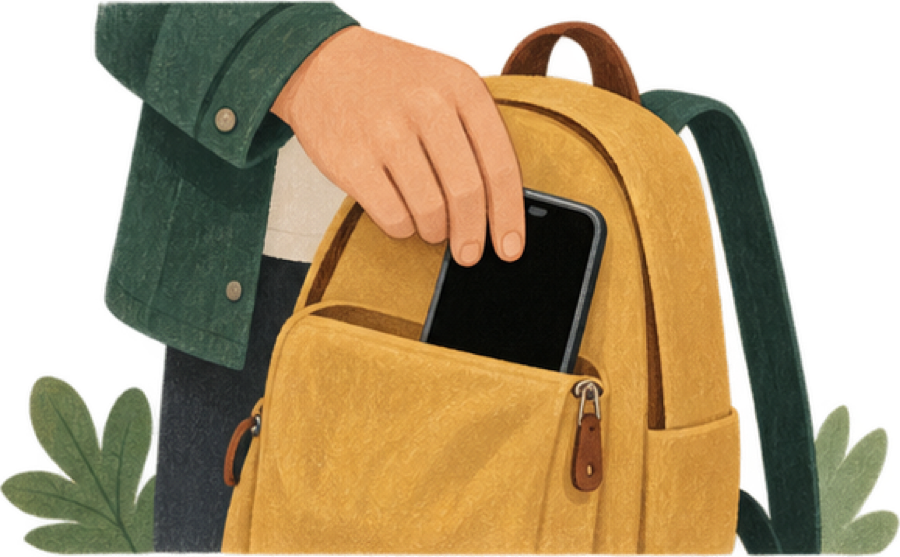
Today, the phone goes in the bag. Ours too.
A screen-free walk doesn't have to be a sacrifice or a strict rule. It can simply be time to look, listen and ask questions together. Here are eight observation games that work with children aged 6 to 9, in a park, in your neighbourhood or on any street in Madrid.
Why screen-free time as a family
In its Family Media Plan, the American Academy of Pediatrics (AAP) suggests setting aside screen-free times and places for the whole family, grown-ups included. It also reminds us that adults are the role models: what we do with our own phones counts as much as what we say.
One of its tips is to plan screen-free activities the whole family enjoys. A walk is the simplest: it's free, needs no preparation and works on almost any day.
Kids this age are often very curious, too. Asking "what do you notice?" is an easy way to follow that curiosity.
Before you go: the phone pact
Agree a simple pact: everyone puts their phone away at the same time, in the same bag. Use it whenever you need directions, a call or help, then put it away again. That way nobody ends up watching someone else's screen, and the pact belongs to everyone, not just the kids.
Eight observation games
1. Nobody else saw it
Each person looks for one thing they think nobody else has noticed. Share them at the end of the walk. The winner is whoever surprises everyone else.
2. The mystery sound
Stop for a minute in silence. Each person picks a sound and describes it without saying what it is: "it's high, it repeats, it comes from above". Everyone else guesses.
3. Colours in order
Find something red, then orange, then yellow… all the way through the rainbow. In autumn, the Retiro and many Madrid parks make it easy.
4. One question each
Each person asks one question about something they see: "why does that tree have leaves like that?", "who put that bench there?". You don't have to answer them all. Some can wait until you're home.
5. The hidden detail
One person picks something small in sight (a shape on a lamp post, a pattern on a tile) and gives three clues. The others have to find it.
6. Textures
Smooth, rough, cold, soft. Find one of each. Watch out for things that shouldn't be touched: the grown-up decides.
7. The memory map
Back home, draw the route together from memory: which way you went and what was in each place. Compare drawings.
8. Tell it as a story
At dinner, everyone tells the walk as if it were an adventure: "First, we found…". It doesn't need to be accurate. The fun is in how each person tells it.
Tips to make it work
- Keep walks short. Ten or twenty minutes is plenty. Better to leave them wanting more.
- No lectures. A screen-free walk is a plan, not a punishment.
- Photos later. If you want a souvenir, take one photo at the end, all together.
- Adults join in. Put your own phone away too, so everyone can enjoy the same time together.
Frequently asked questions
How much screen-free time is enough?
There's no magic number for a walk. The AAP suggests each family decides its own screen-free times and places. Start with a short stretch you all enjoy.
What if they get bored?
Try another game, change path or let them choose the next stop. And a little boredom isn't a problem either.
Do these games improve attention?
We don't promise outcomes. They're simply a fun way to spend time together noticing what's around you.
How we think about it at Paseo y Pista
The Six-Letter Mystery is our first family adventure: a clue-led booklet for exploring the Retiro with children aged 6 to 9, with the phones put away and your attention on the park.
Keep reading: Planning and decision-making at 6–9 and Talking about feelings after a walk.
Sources
- American Academy of Pediatrics, HealthyChildren.org: How to Make a Family Media Plan
- American Academy of Pediatrics, HealthyChildren.org: How to Build Healthy Digital Habits: 5 Tips for Families
- American Academy of Pediatrics, HealthyChildren.org: Creating Positive Experiences for School-Age Children
This article offers general ideas for families. It is not a substitute for advice from health or education professionals.