A digital print is one of the easiest ways to change a wall: you download it, print it and frame it on the same day. This guide is for any adult who wants to decorate a bedroom, a hallway or a kitchen: mums and dads, grandparents, or anyone setting up a child's room.
1. Check the proportions before you choose a size
First, find out what shape the image is, so nothing gets cut off when you print or frame it.
- ISO sizes (A4, A3): the everyday paper sizes. A4 is 21 × 29.7 cm and A3 is 29.7 × 42 cm.
- 2:3 ratio: the long side is one and a half times the short one. It fits 20 × 30, 40 × 60 or 60 × 90 cm frames.
- 5:7 ratio: the shape of 50 × 70 cm frames.
If the print's proportions don't match the frame, that's fine: use a mount (the white card around the picture). As well as filling the gap, it makes any print look more finished.
2. Check it will look sharp
For a sharp print, the usual rule is 300 pixels per inch. A quick sum: divide the pixels on the long side by 118 to get the maximum size in centimetres at good quality. For example, a file 3,508 pixels tall gives about 30 cm, exactly an A4.
If you want it bigger, a little less resolution is usually fine for something seen from a couple of metres away, but don't stretch it much further.
3. At home or at a print shop?
- At home: fine for A4. Choose the best quality setting and matte paper, and turn off "fit to page" if the print is already the right size.
- At a print shop: better for A3 and large sizes. Take the file on a USB stick or email it, and ask for colour printing on 200 to 300 gsm matte paper. For 50 × 70 or bigger, ask about large-format printing.
Always ask for a small test print if the colours matter: every printer shows them slightly differently.
4. Framing without overspending
- Standard frames: the sizes above are sold in almost any homeware shop, with no need for made-to-measure.
- Acrylic rather than glass in a child's room: it's lighter and doesn't break.
- No frame: wooden pegs on a string, coloured masking tape or a wooden board with two clips also look great, especially if you'll swap the prints often.
5. Where and how to hang it
- At the eye level of whoever will look at it. In a child's room, lower than you would in the living room.
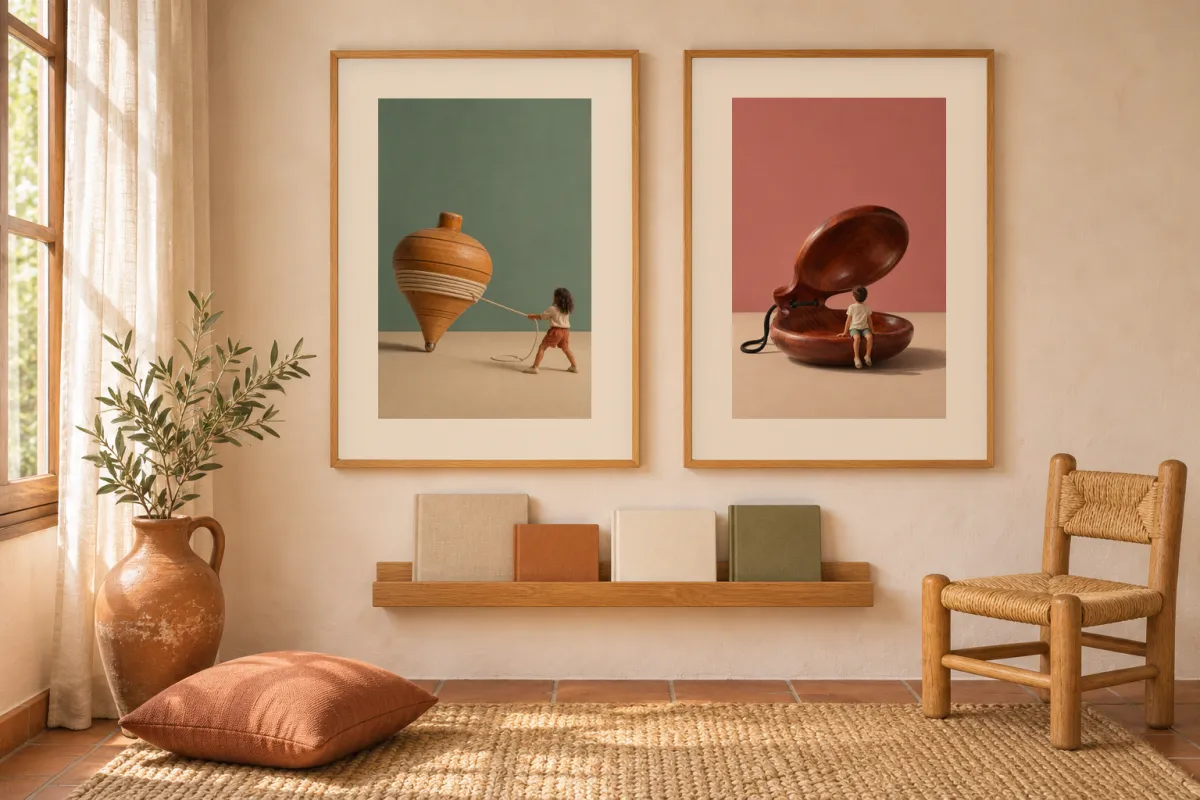
- In groups: two or three prints from the same collection, with the same frame and the same gap (about 5 cm), look better than one big one.
- Away from direct sunlight, so the colours don't fade.
- Securely: on walls where children play, use a two-point hanger or picture-hanging strips rather than a single nail.
A game for choosing them together
Print several candidate prints small, on ordinary paper, and tape them to the wall for a couple of days. Everyone votes for their favourite. The winner goes in the frame. That way the room belongs a little to whoever sleeps in it too.
Our prints
At Paseo y Pista we've drawn prints of Spain to print at home: small scenes of very Spanish things, like the twelve grapes, a churro for a slide or a little toy windmill facing a windmill in La Mancha. They're high-resolution digital downloads to print at home or at a print shop, and they can be hung in groups by collection.