Valencia · Turia Garden · A garden in the former riverbed
The Letter Without a Bridge
Soon you can listen to it too.Until then, read it aloud: it was written for that.
Who hid a letter with no name in Lía’s sketchbook?
Lía finds a letter inside her own sketchbook. There is no name or address, only three arches and a green line.
Read the story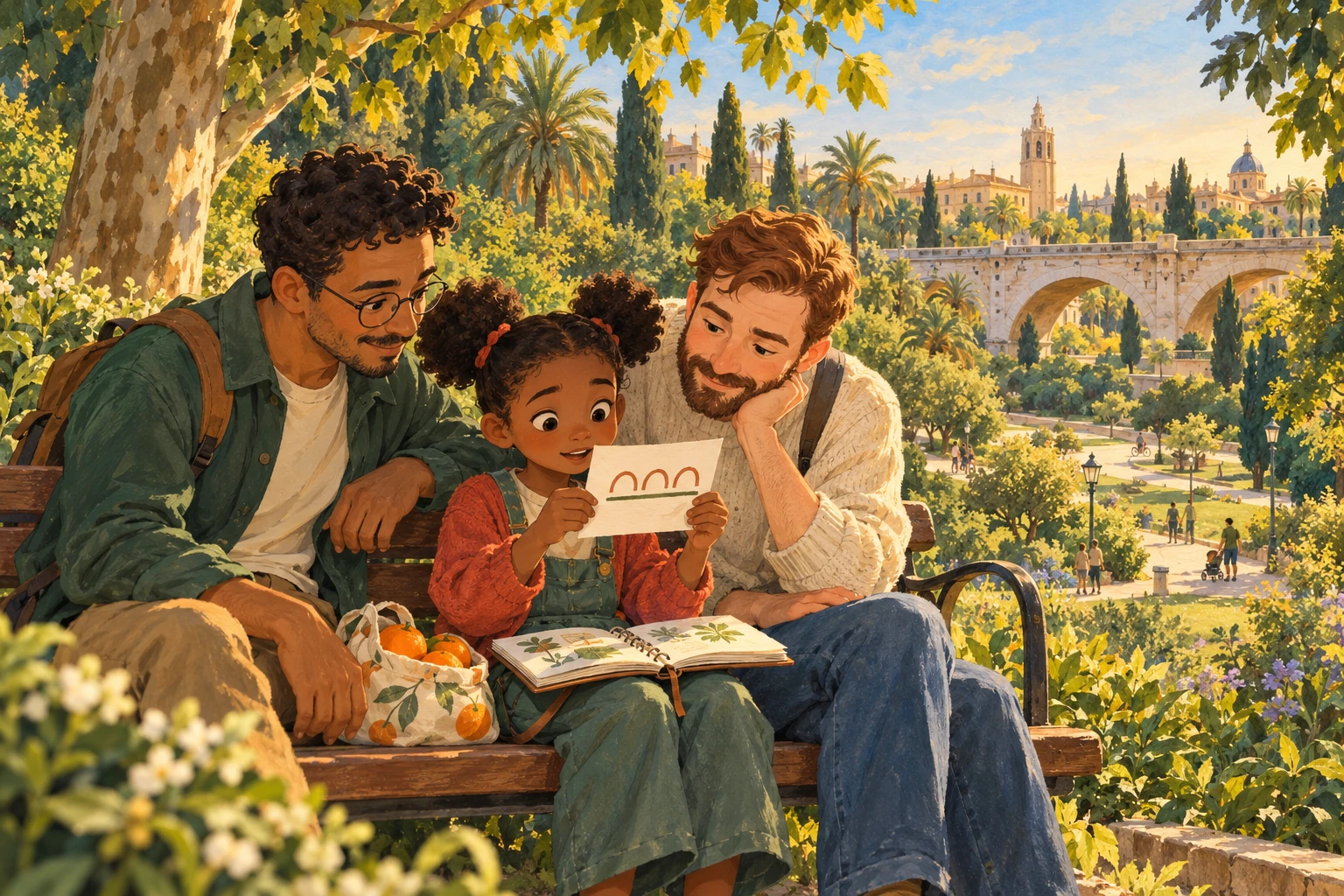
The story
Chapter 1
A letter in the book
The letter wasn’t on the ground or in a postbox. It was inside Lía’s sketchbook, folded exactly in half. She found it during a picnic in the Turia Garden, with her two dads beside her.
The sketchbook was new. Grandma Amparo had given it to her that very morning, at breakfast. On the first page, Grandma had written “For Lía” in round letters.
The letter had no name on it. Inside were three arches and a green line running underneath. In one corner, very small, was an orange circle.
“Did you put it there?”
They both shook their heads, and Lía knew they were telling the truth: Papa Toni had spent breakfast looking for his keys, and Papa Quique making sandwiches.
Lía looked around. The garden filled the river’s old bed. Papa Toni had told her that morning, and she had spent a while imagining fish among the trees.
Chapter 2
A green river
Lía drew blue water under the arches, but something didn’t fit. The line on the letter was green.
“Why would anyone colour a river green?” she asked.
Papa Quique pointed around them: grass, trees, paths.
“Because the river here isn’t made of water any more. It’s a garden.”
So the three arches weren’t three doors or three upside-down smiles. They were a bridge over the garden. A bridge right there.
There was another mark on the paper: an arrow going from one side of the bridge to the other. Lía traced it with her finger. The arrow didn’t say “look”. It said “cross”.
Chapter 3
The same ink
Lía opened the sketchbook at the first page again and put the letter beside it. “For Lía” was written in green. So was the line on the letter.
It was the same ink, the same green. And the round letters of the message matched the round letters peeping through from the back of the letter.
“Grandma,” Lía whispered.
She remembered what Grandma had said at breakfast: “I’ve got a plan in the garden this afternoon.” And she remembered something else: Grandma always carried mandarins in her bag.
Lía pointed to the orange circle in the corner.
“That isn’t a sun. It’s a mandarin.”
Chapter 4
For whoever comes next
They walked to the nearest bridge and crossed it slowly, just as the arrow said. On the other side, under the trees, was a bench. And on the bench sat Grandma Amparo, with a bag of mandarins and an empty space beside her.
“That didn’t take you long,” she said, smiling.
Lía turned the letter over. On the back it said: “For whoever comes next.”
“I crossed first,” Grandma explained. “The letter was for whoever came after me. And here you are.”
Lía didn’t leave the letter in the park, because letters can turn into litter if the wind takes them. She kept it in her sketchbook. Then, while they shared the mandarins, she drew another one: a bench, three arches and a question, “Will you sit with me?”
That one was for her best friend, for Monday. Lía knew how a bridge worked now: someone crosses first and waits for whoever comes next.
✦ The end
After the story
Keep exploring
The Turia Garden occupies the river’s former bed. Its bridges now cross a garden where water once flowed.
Try it together
Imagine your hallway is a river. Which two corners of your home would your imaginary bridge connect? Who would you invite across?
Three words, two languages
- cauce
- riverbed
- arco
- arch
- compartir
- to share