Many homes in Spain speak more than one language. In 2024, one in three babies born in Spain had a mother born in another country (INE, Natural Population Movement 2024). And even if your family only speaks Spanish, your child's class has children who say hello in different ways.
A bilingual story is a gentle way to bring both worlds together: the same story, told in two languages, on the same page. You don't need to speak English to read it well.
Five steps to read it together
- Read in your home language first. The bold line is the Spanish one. The one below, in italics, is the same in English.
- Look for the colours. Words that mean the same share a colour: grande and big, ¡Corred! and Run!. Point to them together.
- Let your child say both. No translating or correcting needed. Just say the coloured word out loud.
- One word, several languages. Every story teaches one word in several languages: ¡Hola!, Hello!, Bonjour!, Salam!
- Add your own. If your family speaks another language, write your word on the activity page.
Why it works at this age
At 3, 4 and 5, children learn by repeating, pointing and playing. That is why every page is short and every key word has its colour pair in the other language: the finger finds the pair before the head translates it.
It is also a story for talking about home and school life: saying hello, sharing, not biting, trying new food, calming down or not being scared of the dark. Each book in the series takes one of those moments.
Bom, the monster with the huge voice
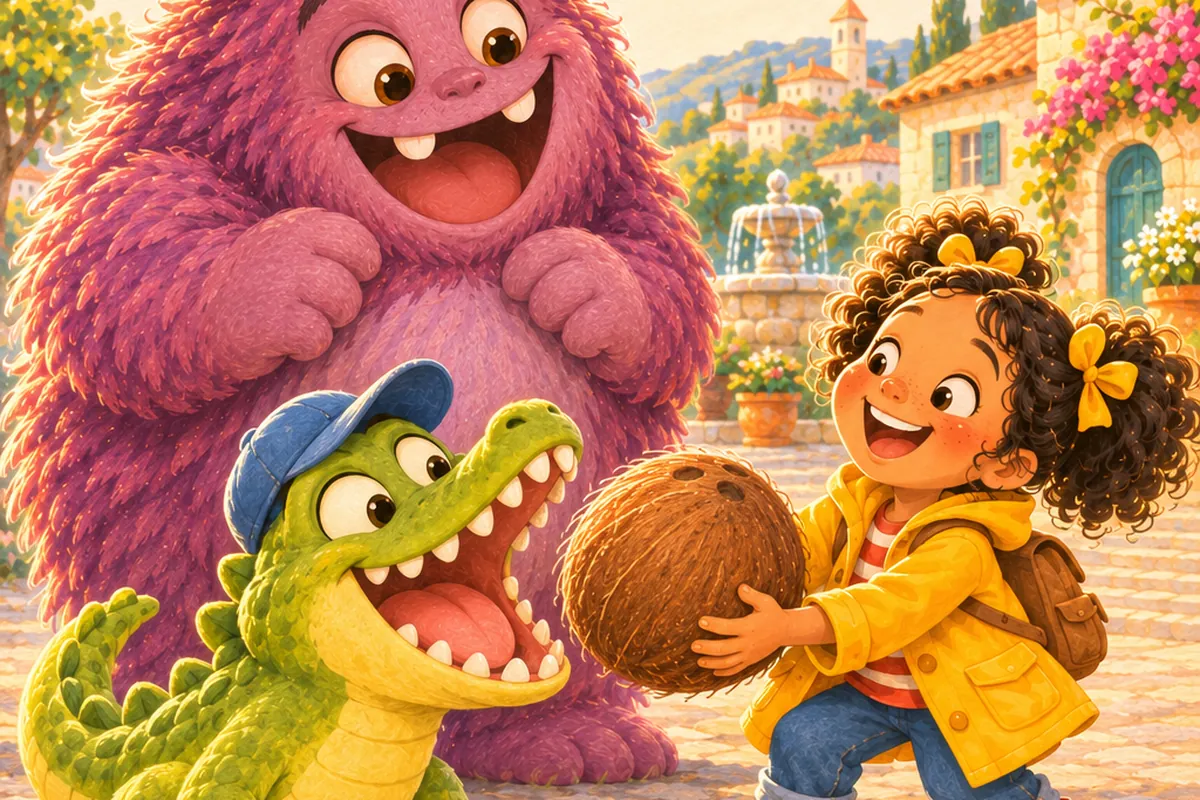
In "Bom's Village", Bom says hello every morning with a huge GRAAAOU! and everyone runs. Until someone listens and understands it means hello. That is the idea behind the whole series: a word you don't understand isn't a scary noise. It might be a hello.
The stories are for children aged 3 to 5, to read with an adult, in Spanish and English. At the end of each book there is a search and find and activities to keep playing. See the "Bom's Village" series.